
Employer of Record in the Philippines: Costs, Rules and Hiring Options
A verified country briefing for employers hiring people who will physically work in the Philippines: employer costs, decision gates, employment rules, exit mechanics and a quote checklist. Sources verified 8 August 2026; next scheduled review 8 November 2026, with immediate updates on any wage, contribution or legal change.
For a worker based in the Philippines, an employer of record (EOR) can be a practical route when your company has no Philippine employing entity and needs a limited or flexible headcount employed lawfully and quickly. It is not automatically the right route. Four Philippine facts surprise most US-based buyers, and each one moves a number or a decision below: there is no national minimum wage, 13th-month pay is a mandatory employer cost, there is no at-will termination, and the country regulates the contracting arrangement itself — where a supply of workers is found to be labor-only contracting, the principal rather than the provider can be deemed the direct employer. The decision still depends on the worker's status and location, immigration needs, cost, control, time horizon and exit plan — and an EOR does not eliminate permanent-establishment, tax, immigration, data-protection, intellectual-property or worker-classification risk. Under the arrangement, a local legal employer handles defined employment obligations while your company continues to direct the day-to-day work; see how an employer of record works if the model itself is new to you.
Statutory employer costs sit on top of salary at roughly 13% to 22% of basic pay — heaviest at the lowest salaries, because three of the four mandatory lines cap — before any provider fee. Everything else on this page keys off the five gates in the next section.
- Choose an EOR if the worker will live and work in the Philippines as a genuine employee, you have no ready Philippine employing entity, and your local headcount is small or uncertain.
- Choose a Philippine entity if you are building a durable local operation where direct employment, control and custom benefits justify formation and ongoing payroll administration.
- Keep a contractor relationship only if the actual working facts support genuine independence — the contract label alone decides nothing.
- Choose neither yet if the worker's location, citizenship, work authorization or employment status is unconfirmed: close those gates first, because every cost line and rule below depends on them.

On this page
- Which hiring route fits this worker? The five Philippine hiring gates
- Philippines employer-cost and rules snapshot
- What would one employee cost?
- EOR, entity or contractor in the Philippines
- Employment rules that change the plan
- Payroll, onboarding and first-payroll workflow
- Compare EOR quotes on the same facts
- Risks an EOR does not remove
- Leaving an EOR: transfer, continuity and what you are left holding
- Choosing a provider at a glance
- Frequently asked questions
- Your first move
- Sources and last verified date
Which hiring route fits this worker? The five Philippine hiring gates
Work through five gates in order; each one narrows the field before any provider conversation starts.
- Where will the worker physically work? The city or region determines the applicable wage order and shapes local requirements — a Metro Manila answer and a Cebu answer are not interchangeable.
- Is the worker a Philippine citizen or a foreign national? A foreign national triggers a separate work-authorization gate that must close before any start date.
- Do you already have a Philippine employing entity? If yes, direct employment — possibly with payroll support — may fit better than paying EOR fees for infrastructure you already own.
- Is the relationship employee-like or genuinely independent? Direction of the work, integration into your team and economic dependence matter more than what the contract calls the person.
- What headcount and time horizon do you expect? Durable scale shifts the economics toward an entity; a small or uncertain footprint favors the EOR route.
| Directional outcome | What must be true before you commit |
|---|---|
| An EOR may fit | A named Philippine employing entity you can verify; a genuine employee relationship; a role whose position under the contracting rules below you have actually tested; provider terms, costs and residual risks acceptable after diligence. |
| A Philippine entity may fit | A modeled break-even against per-employee EOR cost; formation and registration lead time that fits inside your hiring window; local capacity to run payroll, enrollments and statutory filings. |
| A contractor may fit | Facts that support independence under applicable Philippine frameworks — control over method, multiple clients, genuine commercial risk. Do not apply the U.S. "1099" label to Philippine workers. |
| Escalate before choosing | A foreign national needing work authorization; prior contractor exposure; a planned dismissal; permanent-establishment or tax questions; regulated work; collective representation; sensitive data or IP. |
One boundary holds across all three outcomes: a Philippine EOR can serve as the local legal employer, but the client company still directs the employee's day-to-day work and retains its own business, tax and operational responsibilities. The route decides who signs the employment contract — not who owns the outcome.
Is the EOR model restricted in the Philippines?
The Philippines regulates the arrangement itself, and this is the country-specific fact most often missing from provider marketing. Articles 106 to 109 of the Labor Code authorize the Secretary of Labor to regulate contracting and subcontracting and prohibit labor-only contracting, and DOLE Department Order No. 174-17 is the implementing rule. Three features of that rule bear directly on an EOR arrangement.
Registration is mandatory. Contractors and subcontractors must register with the DOLE regional office where they principally operate. Failure to register raises a presumption that the contractor is engaged in labor-only contracting. Registration is a floor, not a shield — DOLE can still find an arrangement unlawful despite a certificate.
"Substantial capital" is a defined threshold. Under DO 174-17, substantial capital means at least PHP 5,000,000 in paid-up capital stock or shares for a corporation, partnership or cooperative, or a net worth of at least PHP 5,000,000 for a sole proprietorship. A contractor without substantial capital or investment, supplying workers who perform activities directly related to the principal's main business, falls inside the labor-only definition.
The consequence lands on you, not only on the provider. Where labor-only contracting is found, the principal is deemed the direct employer of the supplied workers and can be required to regularize them, and Article 109 makes the principal solidarily liable with the contractor for violations of the Labor Code. This is the one Philippine exposure that no service agreement transfers.
None of this makes an EOR arrangement unlawful, and DOLE has separately indicated that the registration regime is not generally aimed at business-process and IT-enabled service companies. It does mean the characterization question is live, and it sharpens as the worker's role moves closer to your core business. Ask any provider for its DOLE registration status and the registered name of its Philippine employing entity in writing, and put the structural question to Philippine counsel where the role sits inside your main line of business rather than alongside it.
Three branches follow from that, and only one of them is "proceed":
- Proceed with an EOR where the role sits alongside your main line of business rather than inside it, the provider names a DOLE-registered Philippine employing entity in writing, and counsel has seen the structure.
- Build the entity instead where the role is core to your main business and the headcount is durable. The characterization question does not arise when you are the employer, and that alone can decide the route before any cost model does.
- Stop and take advice first where the person has already worked as a contractor on employee-like facts. Converting them through an EOR does not resolve the earlier period, and the sequence is counsel first, provider second.
Philippines employer-cost and rules snapshot
Every consequential row below carries a status. Verified: a current official source was opened and supports the exact claim. Verified with limitation: supported, but a stated cap, date, scope or evidence gap restricts the conclusion. Two further statuses exist and are not currently in use on this page. Partial: some fields are verified and the row cannot yet support a complete conclusion. Blocked: the governing source was unavailable or ambiguous, so the row is a research task, not a fact. EOR Hub publishes blocked rows as blocked rather than filling them from vendor guides, neighboring-country figures or prior-year schedules.
Read the tables as a budgeting instrument, not a summary. Statutory rules were verified against the sources shown on 1 August 2026; the volatile rows — contribution schedules, wage orders and work-authorisation rules — were re-opened and re-checked on 8 August 2026. Values are safe to plan against under their stated scope, and a limitation travels with the number it qualifies. The tables run on a 90-day review cadence, with earlier updates whenever a wage, contribution or legal change is identified.
Philippine employer contributions and mandatory pay
| Component | Borne by | Rate or rule | Floor, cap or ceiling | Effective | Status and source |
|---|---|---|---|---|---|
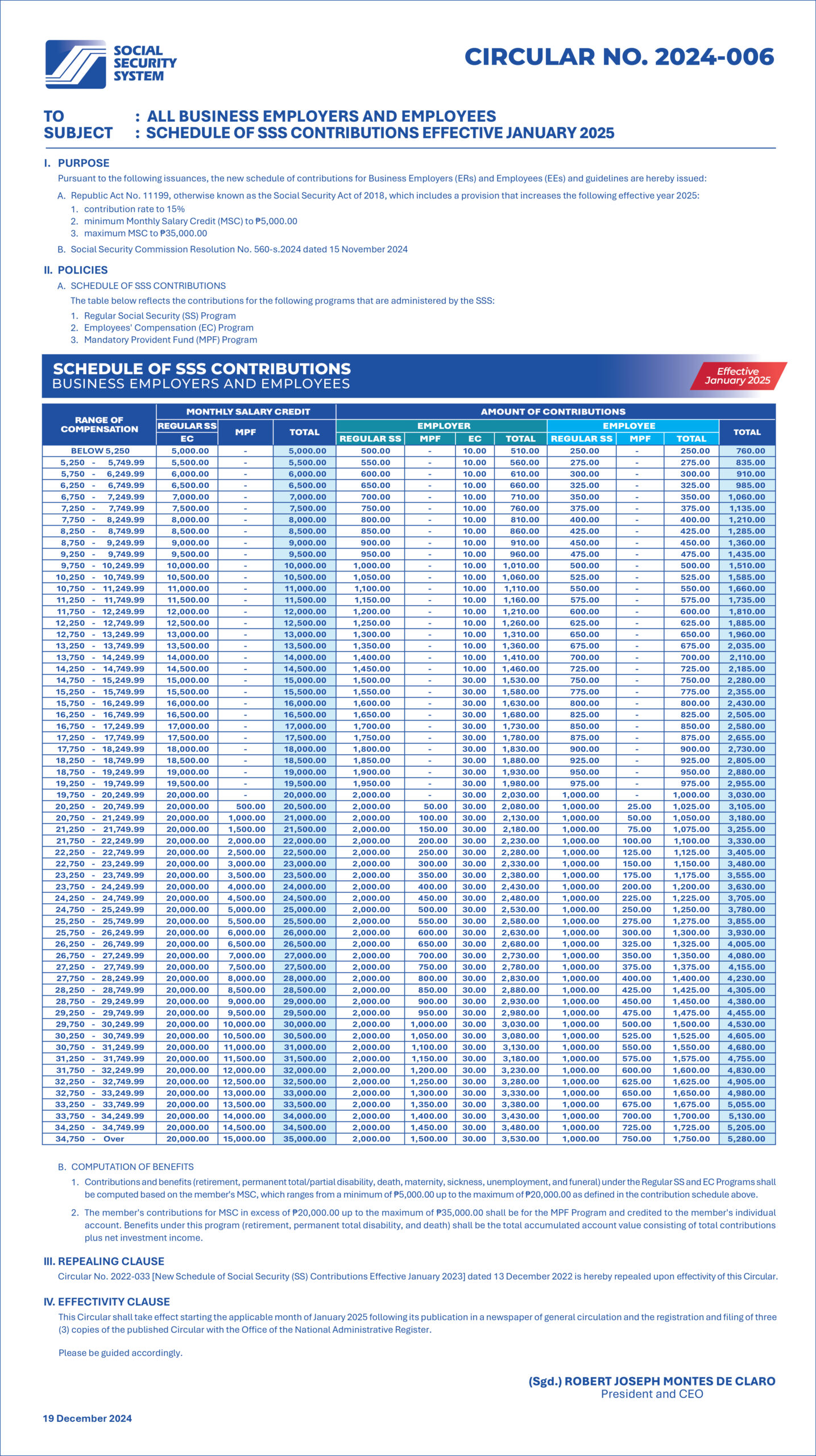
| SSS contribution — employer share | Employer | 10% of the monthly salary credit, plus the Employees' Compensation contribution the employer pays alone (PHP 10 or PHP 30 depending on the salary credit) | Monthly salary credit ceiling of PHP 35,000, so the employer amount stops rising at PHP 3,530 a month | January 2025 schedule, current for 2026 | Verified — SSS contribution table and Circular 2024-006 schedule |
| SSS contribution — employee share | Employee, withheld from pay | 5% of the monthly salary credit | Same PHP 35,000 ceiling, so PHP 1,750 a month at the top band | January 2025 schedule | Verified — same SSS sources. A payroll deduction, not an employer cost |
| PhilHealth premium | Shared equally in formal employment | 5% of monthly basic salary, split 50/50, so 2.5% each side | Floor PHP 10,000 and ceiling PHP 100,000 of monthly basic salary; employer share caps at PHP 2,500 | CY 2026 | Verified with limitation — Advisory 2025-0002 and Circular 2020-0005. CY 2026 retention of the 5% rate, floor and ceiling was reported by the Philippine Information Agency from a PhilHealth advisory issued 6 May 2026. That advisory was released through PhilHealth's own social channels, and no equivalent CY 2026 advisory or circular document could be located in PhilHealth's published index as of 8 August 2026 — so this row rests on the reported advisory rather than on the governing document, and is the one row here that should be re-confirmed against your provider's remittance schedule |
| Pag-IBIG Fund (HDMF) contribution | Employer and employee | 2% of the fund salary from each side above a PHP 1,500 monthly fund salary; the employee rate is 1% at or below PHP 1,500 while the employer rate stays at 2% | Maximum fund salary of PHP 10,000, so each side caps at PHP 200 a month | HDMF Circular No. 460, effective February 2024 | Verified — HDMF Circular No. 460 |
| 13th-month pay | Employer | Not less than one-twelfth of the total basic salary the employee earned in the calendar year, payable no later than 24 December, to every rank-and-file private-sector employee who worked at least one month in the year — regardless of position, designation or employment status, and including those who resigned or were terminated | No ceiling. The only mandatory line that scales with salary without capping | Presidential Decree 851, as restated in DOLE Labor Advisory No. 16, Series of 2025 | Verified — DOLE Bureau of Working Conditions |
| Maternity salary differential | Employer, contingent | Where a covered employee takes maternity leave, the private-sector employer pays the difference between the SSS cash benefit and the worker's regular pay for the whole leave period | Statutory exemptions apply, including retail and service establishments and other enterprises employing not more than ten workers, and qualifying micro-business enterprises | Republic Act 11210 | Verified — RA 11210, Section 5 and the Philippine Commission on Women FAQ |
Philippine wage floors, working time and leave
| Rule | What it requires | Scope or exception | Effective | Status and source |
|---|---|---|---|---|
| Regional minimum wage | Wage floors are set region by region through wage orders issued by regional wage boards under the Wage Rationalization Act; there is no single national rate | Rates differ further by sector and establishment category, and each board runs its own cycle | Varies by order | Verified — National Wages and Productivity Commission, checked 8 Aug 2026. Each regional board publishes its own current daily minimum wage rates with the governing order and its effectivity date — for example NCR for Metro Manila and Region VII for Cebu. Open the board page for the worker's region |
| National Capital Region rate | Wage Order NCR-27 grants PHP 85 a day in two tranches: PHP 60 from 25 July 2026, lifting the non-agriculture floor from PHP 695 to PHP 755 and the lower tier from PHP 658 to PHP 718, and PHP 25 from 20 January 2027, taking those rates to PHP 780 and PHP 743 | The lower tier covers agriculture (plantation and non-plantation), service and retail establishments employing 15 workers or fewer, and manufacturing establishments regularly employing fewer than 10 workers | Issued 23 June 2026, published 9 July 2026, tranche 1 effective 25 July 2026 — implementation currently restrained | Verified with limitation — Wage Order No. NCR-27 and the RTWPB-NCR rate page, checked 8 Aug 2026. On 30 July 2026 the Pasig City Regional Trial Court, Branch 152, restrained implementation of NCR-27 until 13 August 2026, after a status quo ante order of 24 July; a hearing on a longer injunction was held on 3 August and no ruling had been published as of 8 August. While the restraint holds, the governing NCR floors are the NCR-26 rates of PHP 695 and PHP 658. DOLE says first-tranche amounts already received cannot be recovered from workers, and will contest the order (DOLE statement). Confirm the position on signing day |
| Normal hours, overtime and night work | Normal hours of work must not exceed eight a day. Work beyond eight hours carries the regular wage plus at least 25% on an ordinary day. Work performed between 10 p.m. and 6 a.m. carries a night shift differential of at least 10% of the regular wage for each hour | Coverage exclusions depend on the worker's role and category | Labor Code Articles 83, 86 and 87 | Verified — DOLE, Labor Code Book 3 |
| Rest days, special days and regular holidays | Work on a special holiday carries additional compensation of at least 30% of the regular wage, rising to at least 50% where that day is also the employee's scheduled rest day. Regular holidays carry holiday pay | Retail and service establishments regularly employing fewer than ten workers are treated differently for regular holiday pay | Labor Code Articles 93 and 94 | Verified — DOLE, Labor Code Book 3 |
| Service incentive leave | Five days of paid leave a year for an employee who has rendered at least one year of service, usable for sick, vacation or other purposes and convertible to its cash equivalent if unused at year end | Coverage exceptions apply by employee category and establishment size | Labor Code Article 95 | Verified with limitation — DOLE Handbook on Workers' Statutory Monetary Benefits, 2024 edition. Confirm the employee's category before assuming coverage |
| Maternity, paternity and allocated leave | 105 days of paid maternity leave for live childbirth, with an option to extend by 30 days without pay and an additional 15 days for solo mothers. Up to seven days may be allocated to the child's father or an alternate caregiver, over and above the seven-day paternity leave available to married fathers | The SSS pays the maternity cash benefit; the employer's exposure is the salary differential in the table above | Republic Act 11210; Republic Act 8187 | Verified — RA 11210 and the Philippine Commission on Women FAQ |
Philippine probation, termination and separation pay
| Rule | What it requires | Scope or exception | Effective | Status and source |
|---|---|---|---|---|
| Probationary employment | Probation must not exceed six months from the date the employee started working, unless covered by an apprenticeship agreement stipulating a longer period. The standards for qualifying as a regular employee must be made known at the time of engagement | An employee allowed to work after the probationary period is a regular employee by operation of law | Labor Code Article 296 [281] | Verified — DOLE Bureau of Labor Relations, Labor Code Book VI |
| Termination by the employer | Dismissal only for a just cause or an authorized cause. For a just cause, due process means the two-notice rule: a notice specifying the ground with a reasonable opportunity to explain, then a notice of dismissal. For an authorized cause, written notice must go to the employee and to the DOLE regional office at least 30 days before the termination takes effect | There is no at-will termination. Failure to observe procedural due process exposes the employer to indemnity even where the cause is valid | Labor Code Articles 297 to 299; DOLE Department Order No. 147-15 | Verified — DOLE Bureau of Labor Relations termination guidance and Department Order No. 147-15 |
| Separation pay | Due on authorized-cause terminations: at least one month's pay, or one month's pay per year of service, whichever is higher, for redundancy or installation of labor-saving devices; at least one month's pay, or one-half month's pay per year of service, whichever is higher, for retrenchment, closure or disease. A fraction of at least six months counts as one whole year | Not generally due on a just-cause dismissal | Labor Code Articles 298 and 299 | Verified — DOLE Bureau of Labor Relations and the DOLE Handbook on Workers' Statutory Monetary Benefits |
Philippine contracting, payroll, immigration and data obligations
| Rule | What it requires | Scope or exception | Effective | Status and source |
|---|---|---|---|---|
| Contracting and subcontracting | Labor-only contracting is prohibited. Contractors must register with DOLE; non-registration raises a presumption of labor-only contracting. Where labor-only contracting is found, the principal is deemed the direct employer and is solidarily liable with the contractor | Substantial capital is defined as at least PHP 5,000,000 paid-up capital, or net worth for a sole proprietorship | Department Order No. 174-17, 16 March 2017, implementing Labor Code Articles 106 to 109 | Verified — DOLE Department Order No. 174-17 and DOLE, Labor Code Book 3 |
| Payroll frequency | Wages must be paid at least once every two weeks, or twice a month at intervals not exceeding 16 days. No employer may pay less frequently than once a month | Task-based work that cannot be completed in two weeks has its own proportional rule | Labor Code Article 103 | Verified — DOLE, Labor Code Book 3 |
| Foreign-national work authorization | An Alien Employment Permit from DOLE and the corresponding work visa from the Bureau of Immigration must both be resolved before work begins. AEP issuance runs a labor-market test — publication of the vacancy in a newspaper of general circulation remains the mandatory limb — and an economic needs test | Department Order No. 248-B, Series of 2026 moved AEP functions from DOLE regional offices to the Bureau of Local Employment central office, which now receives applications, administers both tests, and issues permits and certificates of exemption or exclusion; regional offices stopped processing on 9 June 2026 | Department Order No. 248, s. 2025, as amended by No. 248-A, s. 2025 and No. 248-B, s. 2026 | Verified with limitation — DOLE Department Order No. 248-A, DOLE AEP requirements and the Philippine Information Agency on centralization, checked 8 Aug 2026. The Bureau is to run the labor-market test through a centralised digital platform, but implementing guidelines had not been issued as of that date, so the newspaper-publication requirement still governs and processing times may move (Fragomen practice note) |
| Data privacy (RA 10173) | Processing of the worker's personal data must follow the Data Privacy Act's principles and safeguards, across the client, the provider and any subprocessor | Applies to all personal data handled in the arrangement | In force | Verified — National Privacy Commission, checked 1 Aug 2026. Provider DPA and subprocessor list still require contract-level review |
What would one employee cost?
Assumptions as of 1 August 2026: a private-sector employee in standard, non-household employment, a Philippine citizen hired locally with no immigration need, based in the National Capital Region, at the monthly basic salary shown. Amounts are Philippine pesos per month.
| Employer cost line | PHP 25,000 salary | PHP 60,000 salary | PHP 120,000 salary | Basis |
|---|---|---|---|---|
| Gross basic salary | 25,000 | 60,000 | 120,000 | The offer. Not the employer cost, and not the employee's take-home |
| SSS + EC, employer share | 2,530 | 3,530 | 3,530 | 10% of the monthly salary credit plus the employer-paid EC contribution; the PHP 35,000 salary-credit ceiling caps this line |
| PhilHealth, employer share | 625 | 1,500 | 2,500 | Half of the 5% premium; the PHP 100,000 ceiling caps this line |
| Pag-IBIG, employer share | 200 | 200 | 200 | 2% of fund salary, capped by the PHP 10,000 maximum fund salary |
| 13th-month accrual | 2,083 | 5,000 | 10,000 | One-twelfth of basic salary, accrued monthly. No ceiling |
| Statutory employer add-on | 5,438 | 10,230 | 16,230 | Contributions and mandatory pay only. Salary and optional benefits excluded |
| Add-on as a share of basic salary | 21.8% | 17.1% | 13.5% | Falls as salary rises because three of the four lines cap |
| Optional benefits | Quote required | Quote required | Quote required | Not statutory, and not modeled here. Providers quote benefits separately: ask what is included, whether pricing is pass-through or marked up, and who administers enrolment |
| Maternity salary differential | Contingent | Contingent | Contingent | Arises only when a covered employee takes maternity leave; sized by the gap between the SSS benefit and full pay |
| Termination reserve | Reserve decision | Reserve decision | Reserve decision | Separation pay is due only on an authorized-cause termination, at one month's pay or between one-half and one month per year of service depending on the ground. Not a monthly cost, but a liability worth funding |
| EOR service fee, setup, deposits or prefunding, FX, event fees, tax on the service fee | Quote required | Quote required | Quote required | Take from itemized quotes. Treat refundable deposits and salary prefunding as cash-flow requirements, not expense |
One line drives the whole spread: the SSS employer contribution, which stops rising once the monthly salary credit hits its PHP 35,000 ceiling. Pag-IBIG caps far lower, at PHP 200, and PhilHealth caps at a PHP 100,000 salary. Only 13th-month pay scales without limit. That is why the statutory add-on is proportionally heaviest on your lowest-paid Philippine hire and lightest on your most senior one — the opposite of the intuition most finance leads bring from percentage-of-payroll models. For the general fee mechanics that sit on top of these lines, compare EOR fees, deposits and FX.
Two separations keep this model honest. First, the employee's own deductions come out of the salary, not out of your budget: at PHP 60,000, the worker's PHP 1,500 PhilHealth share, PHP 1,750 SSS share and PHP 200 Pag-IBIG share reduce take-home pay and add nothing to your cost. Income tax is withheld on top of those, under the graduated schedule in Section 24(A) of the National Internal Revenue Code as amended by the TRAIN Act, which starts at zero on annual taxable income up to PHP 250,000 and rises to 35% above PHP 8,000,000; those same statutory contributions are deducted before the table is applied. Employee deductions are not employer costs, and a refundable deposit is not automatically an expense. Second, the full budget runs wider than the statutory rows:
Estimated employer cash requirement = gross salary + statutory employer costs + mandatory additional compensation + selected benefits + EOR service fee + nonrefundable one-time fees + applicable service taxes + FX cost — with refundable deposits and salary prefunding tracked separately as cash-flow requirements rather than expense.
The provider's fee sits on top of every line above and is quoted rather than published, which is why it appears here as a line to fill rather than a number: fee structures, deposit mechanics and where FX markups hide belong to the EOR pricing guide, which owns those ranges. One Philippine tax question belongs in the same conversation and is almost never raised in a demo. Services performed in the Philippines carry 12% value-added tax under Section 108(A) of the National Internal Revenue Code as amended by the TRAIN Act, while services rendered to a person doing business outside the Philippines and paid in acceptable foreign currency accounted for under Bangko Sentral rules are zero-rated under Section 108(B)(2). Which of the two applies turns on the contracting entity and the payment currency, so ask for the answer in writing rather than assuming the quoted fee is the invoiced amount.
Amounts are kept in PHP throughout; if you convert for a group budget, add the conversion source, rate and date beside the converted figure rather than replacing the peso values. This example is an estimate under stated assumptions, not a quote, a legal opinion or a guaranteed payroll result, and any provider quote adds its own fee stack on top of the statutory picture.
EOR, entity or contractor in the Philippines
Four structures distribute the same Philippine obligations differently. The table compares them on the fields that actually decide the route; the prose below it carries only what a table cannot.
| Structure | Who is the legal employer | Setup time | Cost basis | What you still carry | Termination exposure | When it stops being the right answer |
|---|---|---|---|---|---|---|
| EOR (Philippines) | The provider's Philippine entity, or a third-party Philippine employer it engages — get the registered name in writing | No formation needed; onboarding runs days to weeks, set by the slowest dependency | Per-employee fee plus pass-through statutory cost, benefits, FX and event fees; deposits sit in cash flow | Tax and permanent establishment, immigration, past classification, data, IP — and solidary liability if the arrangement is found unlawful | Just or authorized cause only, with the statutory process; the provider executes it, your company funds the outcome | Headcount and permanence push per-employee fees past modeled entity cost, or you need custom benefits, direct contracts or local management |
| Own Philippine entity | Your own registered Philippine company | Cannot employ anyone until formed and registered | Front-loaded formation, then registration, filing and payroll administration whether you employ one person or fifty | All of it, directly, plus the local capacity to run it | The same statutory grounds and process, run by your own team | The local footprint falls away — exit is winding down a company, not an offboarding |
| Philippine contractor | None; this is not employment, and the contract label does not settle the question | Immediate, which is exactly why it gets used where it should not be | Contract fee only, with no statutory employer add-on — provided the facts genuinely support independence | Classification risk including the period already worked, plus IP and data obligations | Contractual on paper; statutory in fact if the relationship is really employment | The working facts drift toward direction, exclusivity or integration |
| PEO / co-employment (Philippines) | Generally you, through a local entity you already have; the model shares employment administration rather than supplying the legal employer | Depends on the entity you already hold | Administration fee on top of your own payroll | Employer obligations in full, because you remain the employer | Yours, as the employer in fact | You have no Philippine employing entity — then this is not the comparison you are running |
Three things the table cannot hold. Worker experience: enrollment, payslips, benefits and local support run through either your team or the provider's, and the difference is visible to the employee from the first payslip. Exit: leaving an EOR is an offboarding or a transition, leaving an entity is a liquidation, and the two are not comparable projects. And residual risk — tax, immigration, classification, data, intellectual property — stays with your company on every row of that table.
Two of the comparisons have their own pages, because the arithmetic is bigger than a country guide. For entity break-even and the control trade-offs in depth, use the EOR vs a Philippine entity framework. And if the fourth row is the one you are actually weighing, note that PEO terminology and its legal effect vary by country, which is why the distinction is worth settling before you shortlist anyone: use the EOR vs PEO breakdown.
Three situations show where the decision actually turns.
One specialist, no entity, uncertain year ahead. A first Philippine hire with no local infrastructure and a headcount plan that may or may not grow is the textbook EOR evaluation: employment can start without formation, cost scales with one head, and the exit is an offboarding rather than a liquidation. Revisit the math if the team grows past a handful of people.
A planned multi-year team with local management. When the Philippines is a durable operating location rather than an experiment, model entity break-even and the transition requirements early. An EOR can bridge the gap while an entity is formed — but price the transition itself (contract novation, benefits continuity, transfer and offboarding fees) into the plan from the start rather than discovering it in year two.
An independent consultant serving several clients. If the person genuinely controls their methods, carries commercial risk and is not integrated like staff, a contractor relationship may be defensible — but that is a facts-and-law conclusion, not a contract label. Escalate the classification facts and review contractor misclassification risk before relying on the arrangement, especially if the role is drifting toward employee-like direction and dependence.
The structural switching triggers are in the last column of the table above; watch them rather than waiting for a dispute to decide the question for you. One trigger sits outside that table because it is about the provider rather than the route: re-run diligence, whichever structure you chose, if the employing entity changes, a deposit or funding requirement appears mid-contract, or the operating model turns out to differ from what was disclosed.
Employment rules that change the plan
The tables above carry the rates and rules. This section explains what each one does to your plan.
The regional wage gate
There is no single Philippine minimum wage, and NCR-27 is a good illustration of why that matters operationally rather than academically: the order was issued on 23 June 2026, took effect on 25 July, fifteen days after its publication on 9 July, and was restrained by a Pasig court five days after that. The restraint runs to 13 August 2026 unless the court extends or converts it, and while it holds the governing Metro Manila floors revert to PHP 695 and PHP 658. Dates circulated before publication were provisional, which is why some sources still carry an earlier one. A figure that was correct when you built the budget can be superseded, and then contested, before the start date. The wage floor is also not a standalone number — overtime, night, holiday and 13th-month computations all run off the daily rate, so a floor change moves more than the base. Even when the offered salary sits far above any plausible floor, the worker's region still determines which order and which local rules apply. Confirm the worker's actual city or region against the current wage order before the contract is drafted, and never treat a Metro Manila rate as a national proxy.
13th-month pay and mandatory compensation
The 13th month is a real budget line, not an optional benefit, and it is the only mandatory Philippine employer line with no ceiling — which is why it dominates the add-on at senior salaries. Accrue it monthly, keep it on its own line separate from salary and contributions, and reject any quote or calculator that folds it into a single contribution percentage — that blending is exactly how country costs get misstated. The rate alone does not show what happens at the edges. An employee who leaves mid-year is still owed a pro-rated amount, so it is a leaver cost as well as a December cost; and because it is calculated on salary actually earned, unpaid leave reduces it.
Working time and pay premiums
Many Philippine hires support overseas teams across time zones, and the premiums stack: night hours, hours beyond eight in a day, and rest-day or holiday work each carry their own addition. A role scheduled to cover a North American business day is structurally more expensive than the same role on a local day shift, and the difference is contractual rather than negotiable. Model the schedule you actually intend to run — not the one on the job description — before the employment contract is signed, and ask the EOR to price a representative month including the premiums.

Statutory leave and the maternity salary differential
Leave is where the funding question bites, because a statutory fund paying first does not make the benefit free to you: the SSS pays the maternity cash benefit, but the employer pays the salary differential up to full pay. Service incentive leave, by contrast, is a direct employer cost and converts to cash if unused. Map responsibility explicitly with the provider — which leave benefits it administers, which are already funded through contributions you pay, which land as additional employer cost, and how a differential is billed back to you — so leave does not surface as an unbudgeted line after the first absence.
Probation and termination
Plan on cause and process, not at-will flexibility. Three things get conflated here, and none of them is severance in the American sense. Notice is process: a two-notice sequence for a just cause, and thirty days' written notice to both the employee and the DOLE regional office for an authorized cause. Separation pay is a statutory termination payment, owed on authorized-cause grounds and not generally on a just-cause dismissal. A negotiated exit package is neither, and agreeing one does not substitute for the statutory process. The six-month probation cap is the easy part; the standards for regularization must be communicated at engagement, and an employee kept on past the period is regular by operation of law. Ending employment then requires a recognized ground and its matching procedure, and getting the cause right while getting the process wrong still costs money. No summary substitutes for advice on a live case: before any dismissal, non-regularization decision or restructuring affecting a Philippine employee, escalate to qualified Philippine counsel and involve the EOR's local team early. A termination handled without process is often the most expensive risk on this page, and it never appears as a quote line.
Payroll, onboarding and first-payroll workflow
Onboarding through an EOR is a sequence with owners and deadlines, not a signup form. The steps below assume the EOR is the legal employer; your company still owns the inputs — worker facts, compensation decisions, approvals and funding. The provider drafts and signs the local contract, runs payroll and handles the statutory administration inside its scope; your company decides compensation, schedule and role, approves changes and funds every cycle on time. Most first-payroll failures trace to an owner who did not know a step was theirs.
- Confirm the route and start date. Lock the five gate answers and set a start date that respects the slowest dependency. For a foreign national, work authorization must finish first.
- Verify the employment contract. Review terms, compensation lines, schedule, probation standards, IP and confidentiality provisions and contract language before signature. The legal employer signs; you approve the substance.
- Confirm registrations and enrollments. SSS, PhilHealth and Pag-IBIG registration and enrollment sit with the legal employer. Confirm in writing who completes what, and by when. Separate statutory items from optional benefits, and confirm pass-through versus marked-up pricing.
- Confirm the payroll calendar and cutoffs. Get pay dates, change cutoffs and approval deadlines, and check them against the statutory requirement to pay at intervals not exceeding 16 days.
- Fund payroll by the deadline. Late funding is the most common first-payroll failure. Put the funding deadline — and any deposit or prefunding requirement — into your finance calendar before the first cycle.
- Reconcile the first payslip. Check salary, employer contribution lines and employee deductions against the quote and the cost model above. A blended or missing line is easiest to fix on payslip one.
- Manage changes and offboarding through the same channel. Salary changes, transfers, leave and eventual offboarding all run through provider cutoffs; ask for the change workflow and its fees before you need them.
Two boundaries apply throughout. Provider-stated timelines are conditional commitments that depend on your inputs, not guarantees. And a foreign-national hire adds a distinct work-authorization workstream — the Alien Employment Permit and the applicable visa — that must complete before work begins and belongs with a specialist, not a checklist.
Compare EOR quotes on the same facts
Quotes are only comparable when the inputs match. Send every provider the same fact pattern and require itemized responses; a "starting from" figure answers none of the questions that decide total cost. Work through the Nine-Field Quote Parity Checklist below, and record an answer in every field even when the answer is "not disclosed."
| Checklist field | What to capture from every provider |
|---|---|
| Input parity | The same country, worker location, salary, currency, start date, headcount, benefits package, immigration need, contract term and integrations on every request. |
| Legal employer | The named Philippine employing entity, its DOLE contractor registration status, and whether the model is owned/direct, partner or mixed; "not disclosed" recorded as a visible answer, never skipped. |
| Recurring cost | Service fee, statutory employer costs, benefits and FX shown as separate lines, plus any tax charged on the service fee. |
| Cash-flow requirements | Deposit or salary-prefunding amounts, the payroll funding deadline and the refund mechanics, in writing. |
| One-time and event fees | Setup, off-cycle payroll, immigration, contract amendment, termination, severance handling and employee-transfer charges. |
| Contract and exit | Minimum term, notice, cancellation, auto-renewal, refund terms, and who does what in offboarding or a transfer to your future entity. |
| Implementation | Required documents, cutoffs, contract workflow, benefits enrollment and the vendor-stated timeline with its stated conditions. |
| Support and product | Channels, hours, named support model, employee self-service, integrations and Philippine-specific limitations. |
| Security and data | DPA, subprocessor list, certification name with scope and validity date, data-transfer arrangements and incident and access-control commitments. |
Copy this checklist into every quote request and demo agenda so the answers arrive in comparable form. Then weigh the answers, not just the headline fee: a low service fee attached to a large non-refundable setup charge, an undisclosed FX markup or a long minimum term can cost more over a year than a higher, cleaner fee, and a field answered with "not disclosed" is comparable across providers in a way a vague reassurance never is.
The Four EOR Operating Models: owned, partner, mixed or undisclosed
Country availability does not prove that a provider owns a local entity or delivers every service directly — a Philippines flag on a coverage map is a service claim, not an entity record. Four models can sit behind that claim:
| Model | Who employs the worker | What it changes for you |
|---|---|---|
| Owned / direct | The provider's own Philippine entity | One accountability chain: the provider controls the employment workflow, data handling and escalation directly. |
| Local partner | A third-party Philippine employer engaged by the provider | An extra layer in fees, data flow and escalation; ask who answers for payroll errors and termination handling. |
| Mixed | Owned in some countries, a partner in others | The Philippine answer must be confirmed specifically; a global model statement says nothing about this country. |
| Undisclosed | Not stated in current documentation | Ask for the employing entity's name in writing before contracting. |
State a specific provider's model only when its own current documentation supports it; otherwise record it as "Operating model not verified" — and treat that answer as a finding in itself. Three conditions should each generate their own diligence question rather than a generic one:
- If delivery is partner-based in the Philippines: which entity employs the worker, who answers for a payroll or remittance error, who holds the employment records, and what happens to the worker if the partner relationship ends?
- If pricing is quote-only: what does the quote exclude, and which events — off-cycle runs, contract amendments, immigration steps, termination — trigger an additional charge?
- If the operating model is not disclosed: what is the registered name of the Philippine employing entity, is it DOLE-registered as a contractor, and will both go into the service agreement?
Risks an EOR does not remove
An EOR takes on defined employment administration: the local contract, payroll processing and the statutory remittances within its scope. It does not absorb the rest of the risk map, and no provider marketing changes that. What stays with your company:
- Corporate tax and permanent establishment. Whether your company's Philippine activity creates a taxable presence depends on what the worker does and how your business operates — a question for your tax advisers, not an employment vendor.
- Joint and solidary liability. Where a contracting arrangement is found unlawful under the rules above, Philippine law can treat the principal as the direct employer and hold it solidarily liable with the contractor for Labor Code violations. That exposure sits outside anything a service agreement can allocate.
- Immigration. For a foreign national, the work-authorization gate exists regardless of who the legal employer is, and it must close before work begins.
- Worker classification — including the past. A new EOR arrangement does not automatically cure past contractor-misclassification exposure; the earlier period stands on its own facts and may need its own remediation advice.
- Continuity of employment. An employee's service history, accrued entitlements and statutory protections follow the employment relationship, not your vendor contract. Changing providers is an employment event, not an account migration.
- Data protection. The Data Privacy Act applies to the worker's personal data across the whole arrangement, and cross-border transfers, the provider's DPA and its subprocessor list need contract-level review rather than a checkbox.
- Intellectual property and confidentiality. IP assignment and confidentiality must run the whole chain — worker to legal employer, legal employer to your company — because a gap at either link is discovered at the worst possible moment. Read both instruments rather than assuming the provider's template closes it.
- Employee representation. Collective-representation questions can arise in some settings and sit outside standard EOR scope; treat them as a counsel item, not a provider setting.
- Operational ownership. You still direct the work, make the business decisions, meet payroll funding cutoffs and cooperate with lawful process. An EOR is an employment layer, not a transfer of accountability.
Escalate to qualified professionals whenever a dismissal is planned, a foreign national is involved, a prior contractor period exists, permanent-establishment or tax questions surface, the work is regulated, or sensitive data or IP is in play.
Leaving an EOR: transfer, continuity and what you are left holding
Most EOR relationships end — into your own entity, into another provider, or with the employee leaving. Plan the exit while you still have negotiating leverage, which is before you sign.
A transfer is an employment-law event, not an account migration. Moving a worker from the provider's Philippine entity to your new entity, or to a different provider, changes the named legal employer. The employee's service history and accrued entitlements attach to the employment relationship, so how the change is documented determines whether tenure carries across or restarts. A transfer structured as a resignation and a fresh hire can reset service-based entitlements — the wrong outcome for the employee and a dispute waiting for you. Put the mechanism in front of Philippine counsel before it is executed, not after.
Two accrued balances always have to be settled or carried. Pro-rated 13th-month pay is owed to an employee who resigns or is terminated during the calendar year, and unused service incentive leave converts to its cash equivalent. Agree in advance whether the outgoing employer settles them or the incoming one assumes them, and get the accrual balances in writing before the cutover.
Ask for these before signing, not at the exit. Minimum term and the notice you owe. Whether the agreement auto-renews. Termination, severance-handling and employee-transfer fees. What happens to a deposit or prefunded balance, and on what timetable. Who runs the final payroll and files the final statutory remittances. And where records live — contracts, payslips, and proof of SSS, PhilHealth and Pag-IBIG remittance — and how you retrieve them afterwards. If you may ever need to prove compliance for the period you used a provider, retrieval terms are a condition, not a courtesy.
A foreign national's exit is a separate workstream. An Alien Employment Permit is issued against a named employer and position, so a change of legal employer is a work-authorization matter with its own lead time. Involve an immigration specialist at the planning stage rather than the cutover.
Choosing a provider at a glance
This country guide does not rank vendors. Named, evidence-matched comparisons live on the shortlist page, where you can compare verified EOR providers once your gate answers are set. What travels with you from this page is the profile to shortlist for — there is no universal best provider, only better fits for your situation.
Two situations never reach a shortlist at all: a role that sits inside your core business rather than alongside it, and a person with a prior employee-like contractor period. Both are routed in the branches under the contracting rules above, and both come before any demo rather than after one.
| Your situation | Footprint and constraint | Shortlist move | Ask in the demo |
|---|---|---|---|
| Founder making one or two hires, no entity | One country, one or two heads, near-term start date | Providers that name a Philippine employing entity and quote itemized, dated pricing | Who is the legal employer on the contract? Owned entity or partner, and are they DOLE-registered as a contractor? What deposit or prefunding applies, and is it refundable? What does offboarding cost? |
| Finance lead planning several hires and a forecast | One country, several heads, forecast under review | Providers that will quote identical inputs and disclose their FX method | Which lines are fee versus statutory versus benefits? How is 13th-month pay billed — accrued monthly or charged in December? What is the FX source and markup? When must payroll be funded? Is tax charged on the service fee? |
| HR lead hiring into an existing Philippine team | One country, growing team, consistency matters | Providers that document leave administration, contract terms and the employee experience | Who administers leave, and how is a maternity salary differential handled and billed? What does the employee see and self-serve? How are probation standards documented in the contract? |
| Compliance-led team with regulated or sensitive data | One country, sensitive scope | Providers with a current certification scope and a complete data-protection package | What is the certification name, scope and validity date? Who are the subprocessors? How is worker data transferred cross-border? What are the incident commitments? |
| Hiring a foreign national | One country, one head, authorization-gated | Providers that document Philippine immigration scope rather than a generic global-mobility claim | What is your documented AEP and work-visa scope in the Philippines? Who files, and on what timetable? What happens to the permit if the assignment ends early? |
Score every shortlisted provider against the same quote checklist above — identical inputs, identical fields — and record "not disclosed" rather than deleting a row. A provider that cannot complete the card on paper is already answering one of your questions.
Frequently asked questions
Can a foreign company hire in the Philippines without opening a local entity?
Yes — most commonly through an EOR that serves as the local legal employer, or through a genuinely independent contractor relationship where the facts support one. Neither route removes the residual tax, immigration, classification and data obligations covered on this page, and the EOR route carries a Philippine-specific characterization question under the contracting rules. Start with the route gates before choosing.
Are SSS, PhilHealth and Pag-IBIG employee deductions employer costs?
No. Employee shares are withheld from gross salary; employer shares are paid on top of it. Any quote that blends the two into one percentage is hiding your real burden — see the separated lines in the cost example.
Is there one minimum wage for the whole Philippines?
No. Wage floors are set region by region through wage orders and can differ by sector and establishment category. Confirm the worker's region against its NWPC board page before relying on any figure, including one quoted by a provider — and see the regional wage gate for why the Metro Manila order is currently restrained.
Can an EOR automatically sponsor a foreign national to work in the Philippines?
No. Work authorization — the Alien Employment Permit and the applicable visa — is a separate government gate that must close before work begins, and it now runs through DOLE's Bureau of Local Employment rather than the regional offices. Provider immigration support varies by country and contract. Treat any sponsorship claim as unverified until the provider documents its Philippine immigration scope in writing, and put the case in front of a specialist.
Does moving a contractor onto an EOR erase past misclassification risk?
No. The new arrangement governs the relationship going forward; exposure from the contractor period stands on its own facts. Take qualified advice before and during the transition — see risks an EOR does not remove.
How long does onboarding through a Philippine EOR take?
There is no universal timeline. Onboarding commonly runs from a few days to a few weeks, and the clock is set by the slowest dependency: the local employment contract and documents, any registrations the legal employer must complete, the first payroll funding deadline and — for foreign nationals — work authorization, which must finish before work starts. Treat provider-stated timelines as conditional.
How much do Philippine EOR services cost per month?
There is no single answer, and a per-employee list fee is never the total. The statutory employer add-on runs roughly 13% to 22% of basic salary depending on salary level, as modeled in the cost example; benefits, the provider's fee, any tax on that fee, FX and amortized one-time charges sit on top, with deposits or prefunding in cash flow rather than expense. Published fee ranges live in the EOR pricing guide.
Your first move
The working sequence from here: close the five gates, then send the same fact pattern to two or three providers using the quote parity checklist, and route the residual legal, tax, immigration and data questions to qualified reviewers before you sign. The route decision comes last, after the facts — not first, from a coverage map.

Some questions belong elsewhere, deliberately. Provider rankings live on the EOR shortlist. Fee structures and deposit mechanics live in the pricing guide. The entity break-even model lives in the EOR versus entity framework. And if the Philippines is one candidate market rather than a settled destination, the country guides for hiring in Portugal and hiring in India apply the same gates to those markets. And two outcomes are answers rather than delays: if no provider will name a Philippine employing entity for your worker's situation, that is a finding, and if the complete cost model exceeds the role's budget, reprice the role before you reprice the provider.
EOR Hub is an independent publisher. It is not an employer of record, a PEO, a payroll processor, a law firm, a tax adviser or an immigration adviser, and this page is general information rather than advice on your facts.
Sources and last verified date
Last verified: August 8, 2026
Next review: November 8, 2026
- SSS Contribution Table — Social Security System — banded contribution schedule effective January 2025, employer and employee shares, and the monthly salary credit ceiling.
- Employer Contribution Schedule, Circular 2024-006 — Social Security System — employer, employee and Employees' Compensation amounts by compensation band, including the PHP 3,530 top-band employer amount.
- Advisory No. 2025-0002 — PhilHealth — 5% premium rate with the PHP 10,000 floor and PHP 100,000 ceiling on monthly basic salary.
- Circular No. 2020-0005 — PhilHealth — equal employer–employee premium sharing for formal-sector employment.
- PhilHealth sets 5% premium contribution rate for 2026 — Philippine Information Agency — retention of the 5% rate, floor and ceiling for calendar year 2026.
- Circular No. 460 — Pag-IBIG Fund (HDMF) — maximum fund salary of PHP 10,000 and the 1% and 2% contribution rates, effective February 2024.
- 13th-Month Pay Compliance Reminder — DOLE Bureau of Working Conditions — PD 851 and Labor Advisory No. 16, s. 2025: coverage, the one-twelfth computation and the 24 December deadline.
- Handbook on Workers' Statutory Monetary Benefits, 2024 edition — DOLE Bureau of Working Conditions — service incentive leave, premium pay computations and separation pay.
- Labor Code Book 3, Conditions of Employment — Department of Labor and Employment — normal hours, night shift differential, overtime, rest-day and holiday premiums, service incentive leave, payment of wages, and Articles 106 to 109 on contracting and solidary liability.
- Labor Code Book VI, Post-Employment — DOLE Bureau of Labor Relations — the six-month probationary limit and the just causes for termination.
- Termination of Employment guidance — DOLE Bureau of Labor Relations — security of tenure, the two-notice rule, the 30-day authorized-cause notice and separation pay.
- Department Order No. 147-15 — Department of Labor and Employment — standards for applying just and authorized causes and the due process of termination.
- Department Order No. 174-17, Rules Implementing Articles 106 to 109 of the Labor Code — Department of Labor and Employment — prohibition of labor-only contracting, mandatory contractor registration, the PHP 5,000,000 substantial-capital threshold and solidary liability.
- DOLE reaffirms commitment to workers' welfare amid NCR wage hike TRO — Department of Labor and Employment — the 30 July 2026 temporary restraining order against NCR Wage Order No. 27 and the department's response.
- Regional wage boards — National Wages and Productivity Commission — regional wage-setting and the entry point to each board's current daily minimum wage rates.
- Current daily minimum wage rates, National Capital Region — RTWPB-NCR — the NCR-26 and NCR-27 rate schedule by sector and establishment size, with issue, publication and effectivity dates.
- Current daily minimum wage rates, Region VII (Central Visayas) — RTWPB-VII — the Cebu-region rates and governing wage order, shown as the contrast to the Metro Manila schedule.
- Wage Order No. NCR-27 — Regional Tripartite Wages and Productivity Board, NCR — the order itself, its two tranches and its coverage tiers.
- Republic Act No. 11210, 105-Day Expanded Maternity Leave Law — Supreme Court E-Library — the 105-day entitlement, the allocated leave provision and the employer's salary-differential obligation with its exemptions.
- Availment of the 105-Day Expanded Maternity Leave FAQs — Philippine Commission on Women — interaction with paternity leave under RA 8187 and how the SSS benefit is paid.
- Department Order No. 248-A, Series of 2025 — Department of Labor and Employment — supplemental guidelines on Alien Employment Permit requirements and the labor-market test.
- Alien Employment Permit — DOLE National Capital Region — AEP requirements, advisories and application documents.
- DOLE adopts centralized alien work permit processing — Philippine Information Agency — Department Order No. 248-B, s. 2026 and the transfer of AEP functions to the Bureau of Local Employment.
- Republic Act No. 10963, Tax Reform for Acceleration and Inclusion — Supreme Court E-Library — the graduated income tax schedule in Section 24(A), the PHP 90,000 exclusion for 13th-month pay and other benefits in Section 32(B)(7)(e), and the 12% value-added tax on services with the zero-rating rule in Section 108.
- Philippines: Centralized Processing of Alien Employment Permits — Fragomen — practice note on the June 2026 transfer of AEP processing to the Bureau of Local Employment and the labor-market-test guidance still outstanding.
- Data Privacy Act of 2012 (RA 10173) — National Privacy Commission — data-processing principles and safeguards applicable to the worker's personal data.
Not sure what fits your situation?
Answer a few questions and get a shortlist matched to where you are right now.
Take the 2-minute questionnaireKeep reading
 What Is an Employer of Record? Meaning and How It WorksLearn how an employer of record works, which duties stay with your company, what an EOR does not solve, and when another hiring model fits.
 EOR Pricing: Fee Structures, Deposits, and the Fine PrintCompare current EOR fees, deposits, FX costs, and operating models. Use a two-total formula and a quote worksheet to estimate real employer cost.
 EOR vs. Opening an Entity: How to ChooseCompare EOR vs opening an entity across cost, requirements, risks and fit. Use clear decision criteria to choose the better path for your situation.
 EOR vs. PEO: Key Differences and How to ChooseCompare EOR vs PEO across cost, requirements, risks and fit. Use clear scenarios and decision criteria to choose the better path for your situation.